
United States Flag (1860)

United States Flag (1860)

Manifest Destiny

Manifest Destiny

United States Capitol Building (1861)

United States Capitol Building (1861)

The Promised Land

The Promised Land

The United States Capitol Building

The United States Capitol Building

The Star Spangled Banner (1812)

The Star Spangled Banner (1812)

The United States Capitol Building

The United States Capitol Building

The Constitutional Convention

The Constitutional Convention

The Betsy Ross Flag

The Betsy Ross Flag

Washington at Valley Forge

Washington at Valley Forge

Washington at Valley Forge

Washington at Valley Forge

Washington at Valley Forge

Washington at Valley Forge

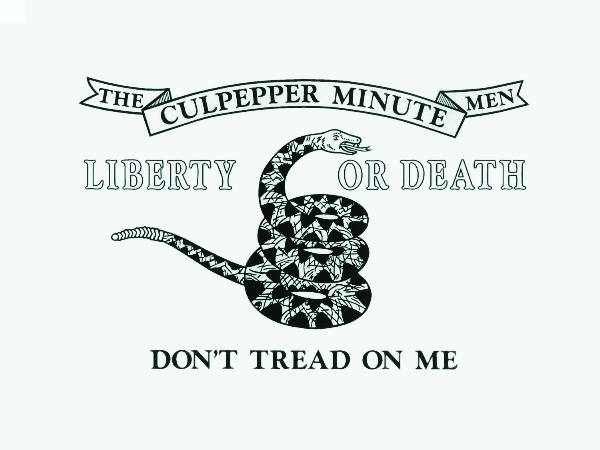
The Culpepper Flag

The Culpepper Flag

Battles of Lexington and Concord

Battles of Lexington and Concord

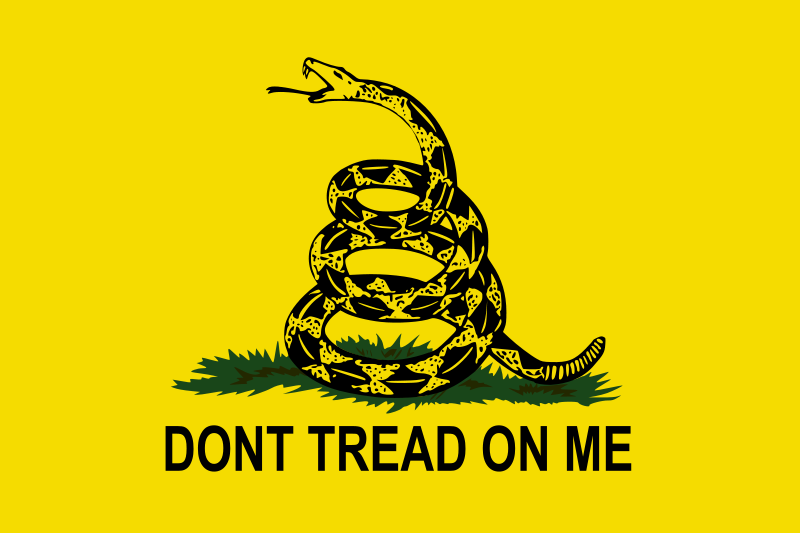
The Gadsden Flag

The Gadsden Flag

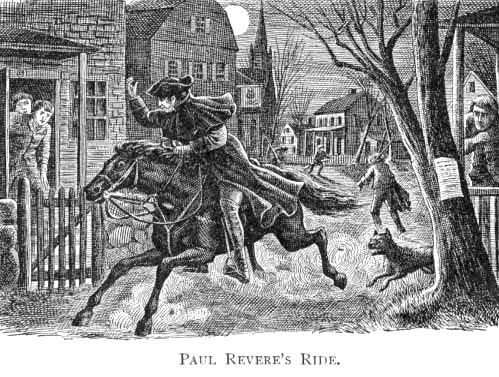
Paul Revere's Midnight Ride

Paul Revere's Midnight Ride

The Grand Union Flag (Continental Colors)

The Grand Union Flag (Continental Colors)

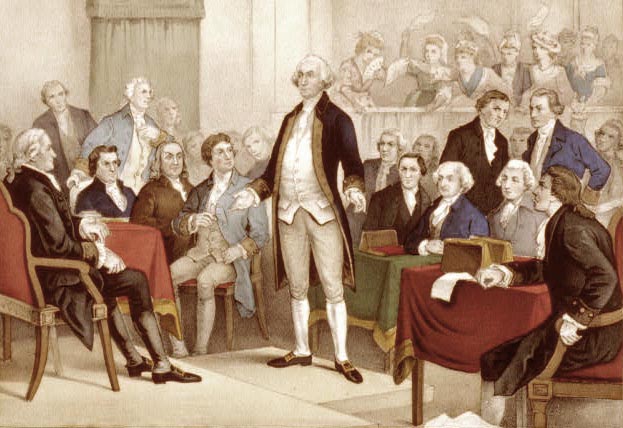
The Continental Congress

The Continental Congress

Sons of Liberty Flag (Version 2)

Sons of Liberty Flag (Version 2)

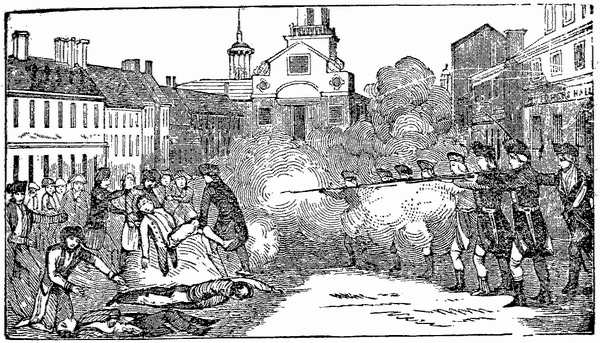
The Boston Massacre

The Boston Massacre

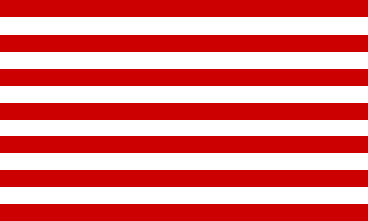
The Sons of Liberty Flag (Version 1)

The Sons of Liberty Flag (Version 1)

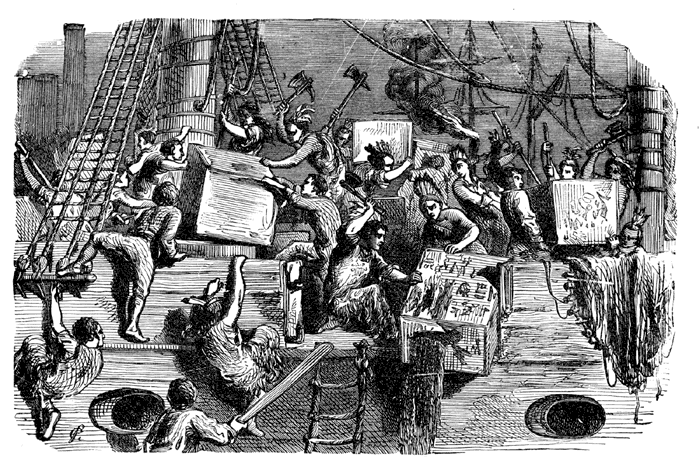
The Boston Tea Party

The Boston Tea Party

Friday, August 12, 2011

Ohio Supreme Court Denies Group's Signature Challenge To Health Care Ballot Issue

From The Washington Post:

Ohio Supreme Court denies group’s signature challenge to health care ballot issue


By Associated Press, Updated: Friday, August 12, 1:07 PM


COLUMBUS, Ohio — Opponents of the federal health care overhaul championed by President Barack Obama scored a key legal victory on Friday that should clear a proposed ballot measure for a fall vote in a pivotal state.


The chance for voters to reject parts of insurance changes will appear Nov. 8, alongside a ballot issue seeking to repeal a contentious rewrite of Ohio’s law restricting collective bargaining. The first is expected to bring out Republican-leaning voters, and the other is expected to bring out Democrats in a state closely divided along political lines.


0


Comments


Weigh In

Corrections?


.


In a unanimous decision Friday, the Ohio Supreme Court rejected a liberal policy group’s lawsuit challenging certification of the issue, to be called the Health Care Freedom Amendment, on the grounds petitions carrying 69,000 signatures were flawed.


ProgressOhio executive director Brian Rothenberg argued that Secretary of State Jon Husted counted signatures on petitions that contained technical errors, including the way paid circulators listed their employment.


Husted, a Republican, argued the challenge revolved around petitions carrying extra information, a practice government should not discourage.


Justices said the secretary of state is “entitled to deference.”


They found that Rothenberg’s charges lacked legal merit, noting “even if his challenge had substantive validity, Rothenberg’s evidence is insufficient to establish that the part-petitions do not have enough signatures.”


Backers of the measure lauded the decision. Ohioans for Healthcare Freedom campaign manager Jeff Longstreth said it will allow “voters to have a choice this fall if healthcare decisions should be made by patients and doctors or politicians in Washington, D.C.”


Husted announced July 27 that the coalition of tea party organizations and other groups behind the measure that submitted 427,000 valid signatures, well over the roughly 385,000 needed to get the amendment on the Nov. 8 ballot.


The proposed amendment to Ohio’s Constitution would keep people from being required to buy health insurance or face penalties. The federal mandate would go into effect in 2014, when new competitive insurance exchanges are scheduled to open.


Opponents say the federal government is overreaching by requiring individuals to purchase a product. The Obama administration counters that Congress’ power to regulate interstate commerce squares the constitutionality of the mandate.


The Ohio court’s decision came as a panel of the 11th U.S. Circuit Court of Appeals in Atlanta struck down the same requirement at issue in Ohio. Other federal courts have ruled or considered the issue, but the Atlanta-based court may be the most pivotal battleground yet because it reviewed a sweeping ruling by a Florida judge.


Rothenberg said ProgressOhio was hindered from fully reviewing all the submitted petitions because 40 percent of Ohio counties refused to respond to a public records request in the time allotted for review.


“Ohioans will now have a choice — to return to the days when children were denied insurance coverage over pre-existing conditions; return to the days when seniors have to choose between prescription drugs and groceries; return to the days when young adults can’t stay on their parents insurance and return to the days when small businesses did not get tax breaks for providing insurance,” he said in a statement. “This fall ‘no’ will be a beautiful word.”


Copyright 2011 The Associated Press. All rights reserved. This material may not be published, broadcast, rewritten or redistributed.

11th Circuit Strikes Down ObamaCare Mandate

From Legal Insurrection Blog:

11th Circuit strikes down Obamacare mandate


Posted by William A. Jacobson Friday, August 12, 2011 at 1:18pm


49


8


This is the big case involving 26 states. In January, Judge Roger Vinson struck the entire law finding that the mandate could not be severed from the rest of the law.


The 11th Circuit ruled that the mandate was unconstitutional, but unlike Judge Vinson, did not throw out the entire law, finging that the mandate could be severed. The opinion is here. [link fixed]


Here is the conclusion summarizing the various aspects of the ruling:


We first conclude that the Act’s Medicaid expansion is constitutional. Existing Supreme Court precedent does not establish that Congress’s inducements are unconstitutionally coercive, especially when the federal government will bear nearly all the costs of the program’s amplified enrollments.


Next, the individual mandate was enacted as a regulatory penalty, not a revenue-raising tax, and cannot be sustained as an exercise of Congress’s power under the Taxing and Spending Clause. The mandate is denominated as a penalty in the Act itself, and the legislative history and relevant case law confirm this reading of its function.


Further, the individual mandate exceeds Congress’s enumerated commerce power and is unconstitutional. This economic mandate represents a wholly novel and potentially unbounded assertion of congressional authority: the ability to compel Americans to purchase an expensive health insurance product they have elected not to buy, and to make them re-purchase that insurance product every month for their entire lives. We have not found any generally applicable, judicially enforceable limiting principle that would permit us to uphold the mandate without obliterating the boundaries inherent in the system of enumerated congressional powers. “Uniqueness” is not a constitutional principle in any antecedent Supreme Court decision. The individual mandate also finds no refuge in the aggregation doctrine, for decisions to abstain from the purchase of a product or service, whatever their cumulative effect, lack a sufficient nexus to commerce. [fn omitted]


The individual mandate, however, can be severed from the remainder of the Act’s myriad reforms. The presumption of severability is rooted in notions of judicial restraint and respect for the separation of powers in our constitutional system. The Act’s other provisions remain legally operaive after the mandate’s excision, and the high burden needed under Supreme Court precedent to rebut the presumption of severability has not been met.


Some thoughts in no particular order:

•Once again a court rejects the belated argument by the administration that the mandate is an exercise of taxing powers. I believe that every court that has considered the issue has ruled against Obama. Remember, during the political debate leading up to passage the Democrats insisted they were not raising taxes with Obamacare, and now those words have come back to haunt them.

•The main opinion is 204 pages, much of which is devoted to explaining how the law works. When Nancy Pelosi said we had to pass it to find out what was in it, she was right. And we need hundreds of pages of judicial decision to tell us.

•The mandate was rejected precisely because it requires people to enter a market rather than regulating a market. I’ll have to spend some more time to see if the court adopted the activity/no activity distinction, but this language certain sounds familiar to people who have been reading Legal Insurrection:


It cannot be denied that the individual mandate is an unprecedented exercise of congressional power. As the CBO observed, Congress “has never required people to buy any good or service as a condition of lawful residence in the United States.” CBO MANDATE MEMO, supra p.115, at 1. Never before has Congress sought to regulate commerce by compelling non-market participants to enter into commerce so that Congress may regulate them. The statutory language of the mandate is not tied to health care consumption—past, present, or in the future.


Rather, the mandate is to buy insurance now and forever. The individual mandate does not wait for market entry. (p. 167)

•In another argument familiar to readers, the Court also pointed out that to accept the administration’s interpretation of the Commerce Clause would mean a limitless federal power:


The federal government’s assertion of power, under the Commerce Clause, to issue an economic mandate for Americans to purchase insurance from a private company for the entire duration of their lives is unprecedented, lacks cognizable limits, and imperils our federalist structure. (p. 171)


Update: On the activity/inactivity issue, the Court accepted that the distinction was legitimate, but found that it was not a complete answer to the health care mandate issue:


As our extensive discussion of the Supreme Court’s precedent reveals, Commerce Clause cases run the gamut of possible regulation. But the diverse fact patterns of Wickard, South-Eastern Underwriters, Heart of Atlanta Motel, Lopez, Morrison, and Raich share at least one commonality: they all involved attempts by Congress to regulate preexisting, freely chosen classes of activities.


Nevertheless, we are not persuaded that the formalistic dichotomy of activity and inactivity provides a workable or persuasive enough answer in this case. Although the Supreme Court’s Commerce Clause cases frequently speak in activity-laden terms, the Court has never expressly held that activity is a precondition for Congress’s ability to regulate commerce—perhaps, in part, because it has never been faced with the type of regulation at issue here. (p.109)

Appeals Court Rules Against ObamaCare Insurance Mandate

From Newsmax:

Appeals Court Rules Against Obamacare Insurance Mandate


Friday, 12 Aug 2011 01:33 PM


A federal appeals court panel on Friday struck down the requirement in President Barack Obama's health care overhaul package that virtually all Americans must carry health insurance or face penalties.


The divided three-judge panel of the 11th Circuit Court of Appeals struck down the so-called individual mandate, siding with 26 states that had sued to block the law. But the panel didn't go as far as a lower court that had invalidated the entire overhaul as unconstitutional.


The states and other critics argued the law violates people's rights, while the Justice Department countered that the legislative branch was exercising a "quintessential" power.


The decision, penned by Chief Judge Joel Dubina and Circuit Judge Frank Hull, found that "the individual mandate contained in the Act exceeds Congress's enumerated commerce power."


"What Congress cannot do under the Commerce Clause is mandate that individuals enter into contracts with private insurance companies for the purchase of an expensive product from the time they are born until the time they die," the opinion said.


Circuit Judge Stanley Marcus disagreed in a dissent.


The 11th Circuit isn't the first appeals court to weigh in on the issue. The federal appeals court in Cincinnati upheld the government's new requirement that most Americans buy health insurance, and an appeals court in Richmond has heard similar legal constitutional challenges to the law.


But the Atlanta-based court is considered by many observers to be the most pivotal legal battleground yet because it reviewed a sweeping ruling by a Florida judge.


U.S. District Judge Roger Vinson's ruling not only struck down a requirement that nearly all Americans carry health insurance, but he also threw out other provisions ranging from Medicare discounts for some seniors to a change that allows adult children up to age 26 to remain on their parents' coverage.


The states urged the 11th Circuit to uphold Vinson's ruling, saying in a court filing that letting the law stand would set a troubling precedent that "would imperil individual liberty, render Congress's other enumerated powers superfluous, and allow Congress to usurp the general police power reserved to the states."


The Justice Department countered that Congress had the power to require most people to buy health insurance or face tax penalties because Congress has the authority to regulate interstate business. It said the legislative branch was exercising its "quintessential" rights when it adopted the new law.


During oral arguments in June, the three-judge panel repeatedly raised questions about the overhaul and expressed unease with the insurance requirement. Each of the three worried aloud if upholding the landmark law could open the door to Congress adopting other sweeping economic mandates.


The arguments unfolded in what's considered one of the nation's most conservative appeals courts. But the randomly selected panel represents different judicial perspectives. None of the three is considered either a stalwart conservative or an unfaltering liberal.


Dubina, an appointee of President George H.W. Bush, is not considered to be as reflexively conservative as some of his colleagues. But he's been under particular scrutiny because of his daughter's outspoken opposition to the health care overhaul. U.S. Rep. Martha Dubina Roby, a Montgomery, Ala., Republican elected in November, voted to repeal the health care law.


Marcus and Hull were both tapped by President Bill Clinton to join the court. But Marcus was also previously appointed by Republican President Ronald Reagan to serve on the Florida bench after several years as Miami's lead federal prosecutor. And Hull, a former county judge in Atlanta, is known for subjecting both sides of the counsel table to challenging questions.


© 2011 Thomson/Reuters. All rights reserved


Read more on Newsmax.com: Appeals Court Rules Against Obamacare Insurance Mandate

Important: Do You Support Pres. Obama's Re-Election? Vote Here Now!

Tuesday, July 12, 2011

The Fourteenth Amendment Is No Blank Check For Debt Increases

From The Heritage Foundation:


The Fourteenth Amendment Is No Blank Check for Debt Increases

Published on July 11, 2011 by Andrew GrossmanLegal Memorandum #68


Print PDF

Download PDF


Share

Facebook

Twitter

Email

More


Abstract: A clause of the Fourteenth Amendment to the United States Constitution provides, “The validity of the public debt of the United States…shall not be questioned.” Far from authorizing the President to incur more debt—a power vested solely in Congress—this clause bars Congress from repudiating debt that it has already incurred. Whether a default would amount to repudiation is an open question, but one that need not be answered at a time when tax revenues are sufficient to service current debt. Not only is the debt limit consistent with the Constitution’s separation of powers, but there is a colorable argument that it, or something like it, is constitutionally mandated.


Liberal legalists and pundits are abuzz with the idea that an obscure constitutional clause empowers the President to burst through the debt limit if Congress declines to raise it. While their focus on the constitutional text is welcome, their theory as to what it means would be merely laughable if some politicians had not begun to embrace it as a way out of a difficult negotiation.


The President has no more unilateral power to issue new debt on the credit of the United States than he has to collect taxes or make expenditures that have not been enacted by Congress. To claim such a power would be unprecedented, unconstitutional, and absurd. Moreover, the affront to the Congress’s rightful prerogatives would be serious, even for those seeking to avoid the hard work of putting the federal budget in order.


Section Four


Section four of the Fourteenth Amendment provides, “The validity of the public debt of the United States, authorized by law, including debts incurred for payment of pensions and bounties for services in suppressing insurrection or rebellion, shall not be questioned.” It also declares “illegal and void” “any debt or obligation incurred in aid of insurrection or rebellion against the United States, or any claim for the loss or emancipation of any slave.”


This clause simply means that Congress and the President cannot question the validity of debt that is already incurred, but it in no way requires the nation to incur more debt. Even if it precludes temporary default—which is far from clear—it could not authorize the President to incur additional debt.


The Fourteenth Amendment was among those proposed and ratified during Reconstruction, and section four was its least-debated provision. During the Civil War, the Union had taken on massive debt to fund the war effort and had promised pensions to wounded soldiers and soldiers’ widows and orphans. The Confederate states had done about the same. Members of the 39th Congress, which excluded representatives of the Confederate states, feared that a future Congress dominated by Southern Democrats would wipe out Union debt and possibly seek to have the federal government guarantee the Confederate debt—an appalling possibility that would reward those who had financed an insurrection and risk political disruption for years to come.[1]


Their solution was to amend the Constitution to declare Confederate debt unenforceable while barring subsequent Congresses from “question[ing]” “the public debt of the United States.” This formulation was somewhat narrower than that of earlier proposals, which stated that federal “obligations”—potentially a more expansive category than debts—would be “inviolable.”[2] But it was also broader than the specific question at hand: the vitality of Civil War debts. This was deliberate. Senator Benjamin Wade, a proponent of the amendment, set forth the rationale:


I believe that to do this will give great confidence to capitalists and will be of incalculable pecuniary benefit to the United States, for I have no doubt that every man who has property in the public funds will feel safer when he sees that the national debt is withdrawn from the power of a Congress to repudiate it and placed under the guardianship of the Constitution….[3]


The Supreme Court’s sole opportunity to interpret and apply section four was in a 1935 case, Perry v. United States, which challenged Congress’s attempt to pay off bonds subject to a gold clause in devalued legal tender. The Court stated:


In authorizing the Congress to borrow money, the Constitution empowers the Congress to fix the amount to be borrowed and the terms of payment. By virtue of the power to borrow money “on the credit of the United States,” the Congress is authorized to pledge that credit as an assurance of payment as stipulated, as the highest assurance the government can give, its plighted faith. To say that the Congress may withdraw or ignore that pledge is to assume that the Constitution contemplates a vain promise…. This Court has given no sanction to such a conception of the obligations of our government.[4]


This principle, said the Court, “applies [] to the government bonds in question, and to others duly authorized by the Congress.”[5]


Constitutionality of the Statutory Debt Limit


Article I of the Constitution vests the power in Congress “to borrow money on the credit of the United States” and the power “to pay the debts and provide for the common defense and general welfare of the United States.” From 1789–1917, Congress authorized nearly all federal debt directly by approving specific loans or issuances of debt instruments to finance specific projects or activities. That changed with the nation’s entry into World War I, which immediately strained the federal budget and led Congress to take a different approach: authorizing the Treasury to issue debt of varying terms in response to market conditions and need while capping aggregate debt.[6] This is, in its essential features, the system in place today.


In this way, the federal government could incur debt at a lower cost without Congress abdicating its constitutionally assigned power and responsibility to authorize and oversee the amount. The debt limit also serves to force Congress “to consider the interests of the general public and future generations…to step back and consider the consequences of its deficit-spending decisions.”[7]


The Constitution vests exclusive power in Congress to raise revenue to fund the government’s obligations, whether by taxes or loans.[8] Congress could not entirely delegate that power to the President, even if it wanted to do so.


Thus, not only is the debt limit consistent with the Constitution’s separation of powers, but there is a colorable argument that it, or something like it, is constitutionally mandated.


An Unconstitutional Usurpation


The Constitution vests in Congress, and withholds from the Executive, the power to commit to spending, to raise revenue by enacting taxes, and to incur public debt. The Fourteenth Amendment does not alter this. Congressional control of borrowing, through the debt limit, and section four of the amendment are in unison, not tension.


First, debt limits do not repudiate existing debt. To “question” “the validity” of a debt is to cast doubt on the obligation itself, not other factors involving repayment. This is true as a matter of common law as well. Insolvency, in itself, does not impugn the validity of a debt, but only the debtor’s present ability to pay. Under federal bankruptcy law, repudiation occurs only with discharge of the bankruptcy petition—the “clean start” that bankruptcy promises. Indeed, a debtor may “affirm” a debt and commit to paying it despite a bankruptcy discharge; in that case, even where payments have lapsed for a time, the debt’s validity has never been questioned.


Second, the Fourteenth Amendment has no bearing at all on most federal spending, because most federal spending is not in service of a debt obligation and is not necessary to pay back existing debt. The Supreme Court has held specifically that Congress can alter government promises, as opposed to vested rights, at any time.[9] It has also held that even “entitlement” programs such as Social Security do not establish property or other rights that the government is constitutionally obliged to observe.[10] While the federal government is obliged to make good on its debts and contractual obligations that it has already incurred, it is not constitutionally committed to carry out other spending.


Even if additional borrowing were curtailed, the government’s revenues are more than sufficient to satisfy current debt payments and avoid a default. At present, debt repayment comprises only a small proportion of total federal spending. Less than 10 percent of total federal spending in the President’s 2012 budget would go to satisfying net interest on the national debt, and some additional percentage would go to satisfying other accrued debts.[11] Looked at another way, deficit spending constitutes about 43 cents of every dollar of federal spending. Thus, even with no deal to raise the debt ceiling, 57 cents of spending on the dollar could continue unimpeded—including all debt payments.[12]


Third, the Fourteenth Amendment does not specify any particular manner by which the obligation to honor the nation’s debt may be met. Congress may, for example, raise taxes, cut spending, or redirect funds to satisfy “public debt.” There is no constitutional requirement that it borrow. So if the President had the unilateral power to issue debt, why would he not also possess the power to raise taxes unilaterally or to sell off government assets?


The answer, as with borrowing, is that these powers are vested in Congress, not the President. No one seriously contends that the drafters of the Fourteenth Amendment intended to place the taxing or selling powers in the President’s hands, which would be a fundamental reorganization of the branches of government and demolish essential checks and balances. So it is with the power to borrow money on the credit of the United States.


Constitutional and Unconstitutional Options


Even if Congress and the President are unable to reach agreement on raising the debt ceiling, the result need not, and probably would not, be default. Revenues are more than sufficient to service the national debt, and history suggests that, even in a revenue-constrained environment, the Treasury would act to avoid default and thereby preserve the full faith and credit of the U.S. government.[13]


In no case does either the Constitution or statutory law afford the President discretion to borrow sums unauthorized by Congress—a point belatedly conceded by the General Counsel of the Treasury Department.[14] To do so would be an unconstitutional usurpation of the legislative power and upend the separation of powers. The result would be a serious separation-of-powers violation by the President, with either Congress taking steps to correct and the courts being asked to resolve on behalf of third parties affected by the impasse. (Whether the courts would or even could act is uncertain, but it is predictable that litigation would cause uncertainty for months or even years.)


No Blank Check


Section four of the Fourteenth Amendment is a limit on Congress’s power to repudiate the nation’s debt and not (almost literally) a blank check for the President. Fair-weather constitutionalists take note: The Constitution was not made for political expedience but to make and keep a Republic.


—Andrew M. Grossman is a Visiting Legal Fellow in the Center for Legal and Judicial Studies at The Heritage Foundation.


Show references in this report


[1]Senator Jacob Howard of Michigan memorably declaimed: “I do not believe in paying traitors, nor do I believe in indemnifying men abroad who, with their eyes open and a malignity in their heart beyond all parallel, gave them aid and comfort. Nor do I see the propriety of keeping this question open before the country, and enabling the foreign holders of cotton bonds to keep the political atmosphere of this country in a turmoil for the future with a view ultimately of getting their pay from somebody. It is time for us to put our hands upon this whole thing and to extinguish all hope.” Cong. Globe, 39th Cong., 1st Sess. 2768 (May 23, 1866) (statement of Senator Jacob Howard).


[2] See id. at 2769 (statement of Senator Benjamin Wade).


[3] Id.


[4]294 U.S. 330, 351 (1935).


[5] Id. at 354. See also Bowen v. Public Agencies Opposed to Social Security Entrapment, 477 U.S. 41, 55 (1986) (section four applies only to property rights and vested contractual rights).


[6]D. Andrew Austin and Mindy Levit, The Debt Limit: History and Recent Increases, Congressional Research Service Report No. RL31967, Jan. 6, 2011, at 4–5.


[7]Anita Kirshnakumar, In Defense of the Debt Limit Statute, 42 Harv. J. on Legis. 135, 137 (2005). For a period, however, Congress did turn its back on this power through a procedural mechanism known as the “Gephardt Rule” that purported to allow the House of Representatives to raise the debt limit without having to vote directly on the issue. While politically expedient, this procedure was irresponsible and constitutionally dubious.


[8]U.S. Const. art. I, § 7, cl. 1.


[9]“[C]ontractual arrangements, including those to which a sovereign itself is party, remain subject to subsequent legislation by the sovereign.” Id.


[10] Flemming v. Nestor, 363 U.S. 603 (1960).


[11]Heritage calculations using Congressional Budget Office, “The Budget and Economic Outlook: Fiscal Years 2011 to 2021,” January 2011, at http://cbo.gov/ftpdocs/120xx/doc12039/01-26_FY2011Outlook.pdf (July 8, 2011).


[12]J. D. Foster, Ph.D., “Congress Has Time and Options on Debt Limit,” Heritage Foundation Backgrounder No. 2511, January 27, 2011, at http://www.heritage.org/Research/Reports/2011/01/Congress-Has-Time-and-Options-on-Debt-Limit.


[13] See id.


[14]Letter from George Madison, General Counsel, U.S. Department of the Treasury, to the New York Times, July 8, 2011, available at http://www.treasury.gov/connect/blog/Pages/FACT-CHECK-Treasury-General-Counsel-George-Madison-Responds-to-New-York-Times-Op-Ed-on-14th-Amendment.aspx.

The Left’s 14th Amendment Lie

The Left’s 14th Amendment Lie

Is Our Government Actively Re-Writing History?

From Vicki Goes To Washington:

BREAKING NEWS: Is Our Government Rewriting History?


Posted on July 12, 2011 by Victoria Jackson


Is our Government Re-writing History?


During the Capital Building tour, our elderly doyen rattled off a lot of facts about the sculpture and paintings in the beautiful rotunda. He “forgot” to mention two of the eight paintings displayed in front of us. He “forgot” to mention, ”Exportation of the Pilgrims,” so I asked him about it. I asked him if the Bible was the book in the painting. He said yes and that he would “get back to it.” He never did.


Embarkation of the Pilgrims by Robert W. Weir


(The painting shows William Brewster, holding the Bible, and pastor John Robinson leading Governor Carver, William Bradford, Miles Standish, and their families in prayer.)


"We'll come back to that..."


He quickly mentioned the other omitted one, “The Baptism of Pocahontas” by John Gadsby Chapman and moved on. The other six paintings were thoroughly described.


We later confronted the doyen and asked him why he had omitted Christian references from the tour. He mumbled something about being in seminary, looked at the ground and walked away.


Washington Monument

Next, we visited the Washington Monument. This was the 4th of July weekend. At the foot of the monument, we waited in a long, roped off line listening to Mexican (not American) music being played nearby.


The Park Rangers told us to divide up into groups of eight. They told us where to wait for the elevator. The stairs where you can see Bible verses carved into the stone blocks are not open to the public anymore. The rangers rattled off many facts about how tall and wide the monument was, what the stones were made of and why they were different colors, but nothing about George Washington, for whom the edifice was erected, and no mention of the Bible verses that we are not able to see anymore; the stone blocks that we cannot see say; “Holiness to the Lord” (Exodus 28), “Search the Scriptures” (John 5:39), “The memory of the just is blessed” (Proverbs 10:7) — and such invocations as, “May Heaven to this Union continue its Benefice.”


There were 3 things I wanted to learn. I got an email a year ago about the Latin phrase “Laus Deo” that was supposedly engraved on top of the Washington Monument. I wanted to know if that was true. I also wanted to know if it was true that George Washington’s Bible, a newspaper, some money of the time, and the Constitution were buried in the cornerstone of the monument. Nick, our paid bus tour guide had told us this information. I also wanted to see for myself if D.C. tour guides were purposefully erasing our Christian heritage, if history was being rewritten.


(This montage is slightly out of order. The blonde ranger is seen here for the first time commenting on our earlier encounter which you see right after). My Flip Camera ran out of time (60 minute limit) right when the blonde ranger started to talk to me the second time. I grabbed my cameraperson, Jan, “Do you have your camera? Get it out! Get it out!” By the time she got it out of its case and hooked up the mike wire, etc., the blonde ranger had finished telling us -


“We’re told to be neutral. If I mention God, I have to mention Allah, Mohammed, Buddha…”


I regaled, “What does Allah have to do with historical fact?! “Laus Deo” is either there or it’s not! It’s history! Fact! It has nothing to do with religious tolerance!” I was waiting for someone to say that stupid phrase “separation of church and state” because I’d just read a David Barton book explaining how that phrase is not in any of our documents, but was plucked from a private Jefferson letter to the Connecticut Baptists assuring them that the new government would not prevent them from preaching the gospel. I wanted to show off my new knowledge. To my surprise the Park Rangers did not use that ACLU phrase – they just “played dumb.”


I was getting very angry and not at the rangers but at Jan, my video cameraperson who was still fiddling with the video camera. I was furious at myself for not bringing an extra Flip camera or at least learning to work her camera. I wanted to yank it out of her hands.


Citizen Journalism is hard work. It is a necessity now that the media is propaganda. You and me are the journalists. We have cameras, eyes, and ears. We will record the truth because NBC, CBS, ABC, and especially CNN, HLN and MSNBC are not telling the truth. Every stranger I interviewed agreed to that. (montage to come)


So, we took the elevator back down and I asked to speak with the “boss” of the Park Rangers. As I was pushed aside to a holding area to make room for the tourists rushing in, I again urged Jan to get her camera ready. She was fiddling with the wires and the fancy microphone that slides on top. Finally, an intense red-faced man in a ranger uniform and hat with a pony tail sticking out approached me and started to shout at me for about 15 minutes. I asked him why none of his rangers could answer my simple questions about the buried Bible and the engraved, aluminum cap stone. He changed the subject several times, going off on nonsensical tangents. He then said his employees were new and didn’t know all the facts. I brought up the 25 year ranger.


Boss replied, “The people who work here aren’t the brightest bulb in the drawer,” something to that effect.


I insisted, “But…the information is right there, why can’t they say it?”


Boss shouted, “Are you saying you don’t trust the government?!”


“Yes!” I shouted back. “I don’t trust the government!” They are re-writing history like George Orwell predicted in his book “1984!”


He didn’t get the reference.


I sighed, “Why don’t you instruct them to say, ‘I’m sorry ma’am, I’m not allowed to answer that question’ – at least, that would be honest.” (Be honest about your dishonesty.)


Knowing I was spent, his voice calmed a bit and he said, “Is that what you want us to say?”


I mumbled “yes”. I was sad. My suspicions were true. Whether or not I got the video to prove it, my America is being destroyed from within.


As Jan and I briskly walked away, knowing our tour group was mad at us for lagging behind, again, I desperately inquired, “You got it, I hope. Did you get it? Oh my goodness, I hope you got that…” Jan said, “I couldn’t hear it.”


“What?!” My face twisted into rage. I took the camera out of her hands and stuttered, “Hhh…hhow do you rewind?”


Long story short, she did get it, although the microphone cord was plugged into the wrong hole, the camera’s built in mike got it, however, desperate rewinding and forgetting to take the tape out….it was taped over. Yeah. I’ll never be a Breitbart.


“Stuff” happens.


Yes, we are still friends. I held in my anger for five hours. I did not cuss. I did not swear. I was on a bus full of Christians. I could not pray, I was too mad. By evening, I told myself that life would go on and that next time I was a citizen journalist I would bring an expert cameraperson, or just do it myself.


Where’s James O’Keefe and Hannah Giles when you need them? Hey, their cameraman was so good Hannah married him! For real!


*To comment to the National Park Service, you can e-mail the NPS or the White House, or write: Director, National Park Service, Department of the Interior, 1849 C Street, N.W., Washington, DC 20240.


****************************************

For extra reading on “Laus Deo” at Free Republic http://www.freerepublic.com/focus/fr/1062177/posts


A prayer of George Washington:


“Almighty God; We make our earnest prayer that Thou wilt keep the United States in Thy holy protection; that Thou wilt incline the hearts of the citizens to cultivate a spirit of subordination and obedience to government; and entertain a brotherly affection and love for one another and for their fellow citizens of the United states at large. And finally that Thou wilt most graciously be pleased to dispose us all to do justice, to love mercy, and to demean ourselves with that charity, humility, and pacific temper of mind which were the characteristics of the Divine Author of our blessed religion, and without a humble imitation of whose example in these things we can never hope to be a happy nation. Grant our supplication, we beseech Thee, through Jesus Christ our Lord. Amen.”


Unless the Lord watches over the city, the watchmen stand guard in vain. (Psalm 127: 1)


This entry was posted in Christianity, Video. Bookmark the permalink.

Obama Executive Orders Impose New Gun Rules

From The Blaze:

Obama Executive Orders Impose New Gun Rules


Posted on July 12, 2011 at 6:51am by Buck Sexton


A few days ago, the Blaze reported on the low-key plans of the Obama administration to increase the penalties for certain gun law violations, and add steps to the background checks for legal gun ownership.


Today the administration’s plans are beginning to come into effect. Through an Executive Order, the Obama administration is implementing new restrictions on the sale of certain weapons in border states, and increasing the penalties for violating certain firearms laws.


Fox News is reporting on the purpose of the gun control executive orders:


“In an effort to stem the illicit flow of weapons into Mexico, the Justice Department announced Monday that all gun shops in four Southwest border states will be required to alert the federal government to frequent buyers of high-powered rifles.


Under the new policy, federal firearms licensees in Texas, California, Arizona and New Mexico must report purchases of two or more of some types of rifles by the same person in a five-day span. The requirement applies to purchases of semi-automatic rifles that have detachable magazines and a caliber of greater than .22.


ATF estimates it will generate 18,000 reports a year. ATF will retain the information and if no investigative leads have been realized after two years, it will be purged.”


The Daily Beast seems to have the inside track on more Executive Orders, however, claiming recent conversations with administration officials. TDB says the upcoming Executive Orders will have more impact than what Fox outlines above, including:


“A national electronic system designed to make background checks for handgun buyers simpler and faster, leaving an electronic paper trail. [And] Tougher sentencing guidelines for straw buyers that Holder’s department pushed through procedural hoops at the U.S. Sentencing Commission earlier this year.”


The Executive Orders come in the middle of the “Fast and Furious” scandal currently plaguing the administration. Already, there is talk on Capitol Hill of a cover-up at the highest levels of government, and it appears to some that the administration was feeding the lethal problem of firearms trafficking it ostensibly intended to address with “Fast and Furious.”


The question remains- if these Executive Orders are ‘common sense’ measures as the administration claims, why not let Congress enact them as laws? And if they are minor tweaks to existing law as others claim, are they necessary at all?


As background, here is a short clip of then-candidate Obama in 2008 on gun control. He agrees that the second amendment means…something, but beyond that, the details get hazy.